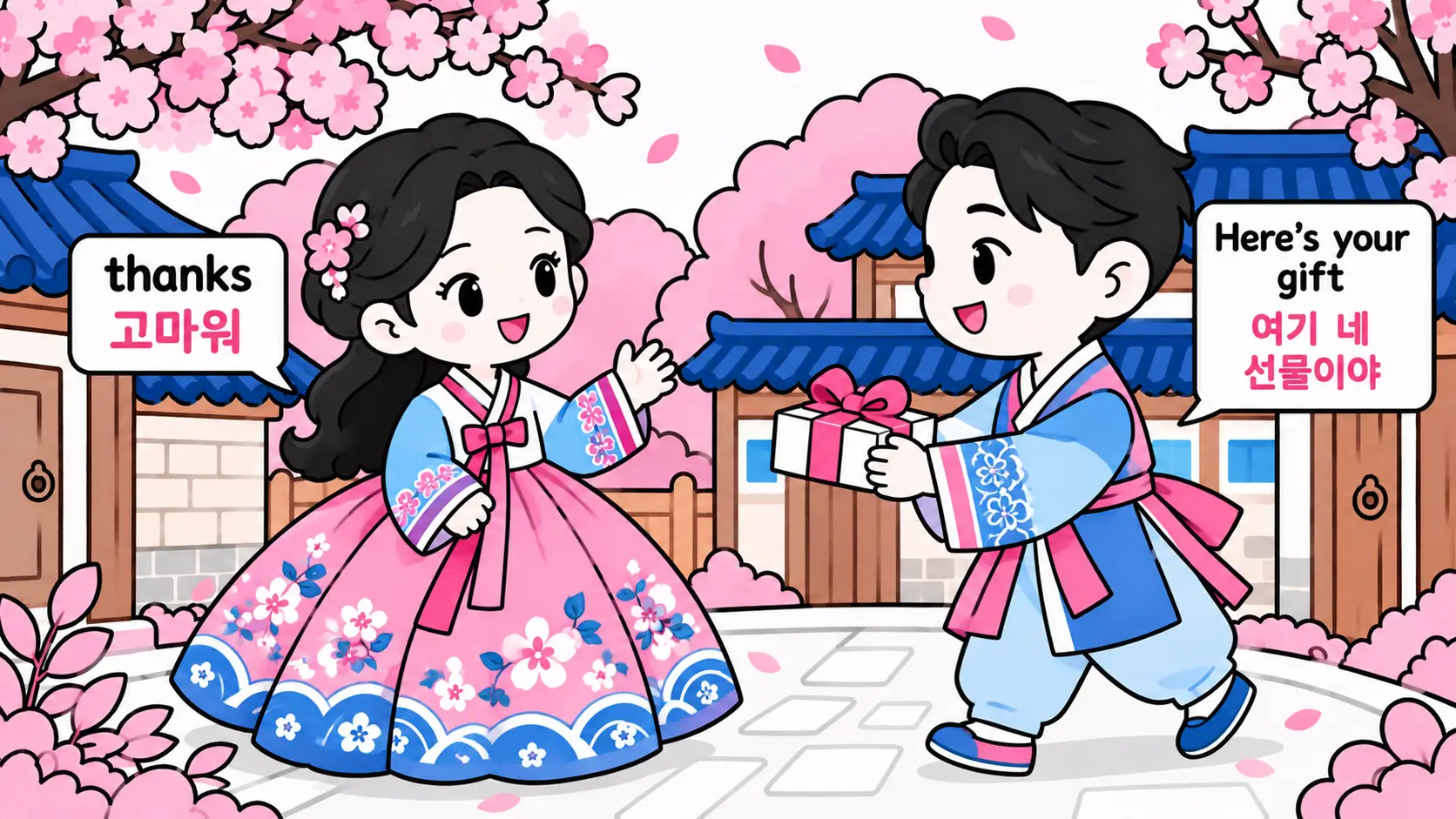
The most common way to say thank you in Korean is 감사합니다 (gamsahamnida). It’s polite, works in most situations, and is a safe choice for beginners.
But how you say thank you in korean directly depends on who you’re talking to. You wouldn’t thank your boss the same way you thank your best friend. In Korean, age, respect, and relationships matter.
Don’t worry! You only need a few simple phrases to get started. In this guide, I’ll show you formal, polite, and casual ways to say thank you in Korean, with easy examples you can use every day.
How to Say “Thank You” in Korean: Formal vs. Informal
The most common way to say thank you in Korean is 감사합니다 (gamsahamnida). It means “thank you” and is a safe choice for beginners in most situations.
You can use 감사합니다 (gamsahamnida) with strangers, 고마워요 (gomawoyo) in polite conversations, and 고마워 (gomawo) with close friends.
Here’s a quick comparison to help you choose the right way to say thank you.
6 Main Ways to Say Thank You in Korean
| Politeness level | Korean (Hangul) | Romanization | When to use |
| Formal | 감사합니다 | gamsahamnida | Strangers, teachers, workplace |
| Formal | 고맙습니다 | gomapseumnida | Respectful conversations |
| Polite / Standard | 감사해요 | gamsahaeyo | Polite everyday speech |
| Polite / Standard | 고마워요 | gomawoyo | Friendly but respectful conversations |
| Informal | 고마워 | gomawo | Close friends, family |
| Informal | 감사해 | gamsahae | Familiar, casual conversations |
If you’re new to the Korean language, I recommend starting with 감사합니다. It’s one of the safest and most useful phrases to learn.
As you learn how to say thank you, you’ll notice that Korean uses different speech endings. These help you choose the right level of formality.
“Thank You” in Korean (Formal)
The two main formal expressions are 감사합니다 and 고맙습니다. Both are used to express gratitude and show respect.
You’ll hear these phrases in schools, workplaces, shops, and other formal situations where polite speech matters.
감사합니다 (gamsahamnida)
감사합니다 (gamsahamnida) means “thank you” in formal Korean. It’s one of the most useful Korean greetings and polite expressions you’ll learn.
감사합니다 (gamsahamnida) means “thank you” in formal Korean. It’s the most common formal way to thank someone.
You can use it with teachers, older people, strangers, and coworkers. It’s also a good choice in a business setting.
You’ll hear it in restaurants, shops, offices, and public announcements. I suggest making it your default expression whenever you’re unsure which politeness level to use
Example sentences:
– Example sentences:
- 도와주셔서 감사합니다.
Dowajusyeoseo gamsahamnida.
Thank you for helping me. - 선생님, 감사합니다.
Seonsaengnim, gamsahamnida.
Thank you, teacher. - 와 주셔서 감사합니다.
Wa jusyeoseo gamsahamnida.
Thank you for coming.
You can check the meaning and pronunciation of these phrases in the Korean-English Learners’ Dictionary, published by South Korea’s National Institute of Korean Language.
고맙습니다 (gomapseumnida)
고맙습니다 (gomapseumnida) also means “thank you” in formal Korean. It comes from the native Korean verb 고맙다 (gomapda).
Both formal expressions are respectful. You can use 고맙습니다 when thanking someone politely for their time, kindness, or help.
It’s another formal and respectful way to express appreciation. You might use this phrase when someone has gone out of their way to help you.
Example sentences:
- 선물 고맙습니다.
Seonmul gomapseumnida.
Thank you for the gift. - 기다려 주셔서 고맙습니다.
Gidaryeo jusyeoseo gomapseumnida.
Thank you for waiting. - 친절하게 설명해 주셔서 고맙습니다.
Chinjeolhage seolmyeonghae jusyeoseo gomapseumnida.
Thank you for explaining it kindly.
“Thank You” in Korean (Standard)
The standard polite ways to say thank you in Korean are 감사해요 (gamsahaeyo) and 고마워요 (gomawoyo).
These phrases are slightly less formal than the expressions above, but they’re still respectful. They work well in friendly everyday conversations.
감사해요 (gamsahaeyo)
감사해요 (gamsahaeyo) means “thank you” or “I’m grateful.” It’s a polite form of 감사하다 (gamsahada).
You can use it to express appreciation to someone you know. However, it’s less common than 고마워요 in everyday speech.
This polite form works when you want to sound sincere without using very formal language.
Example sentences:
- 항상 응원해 주셔서 감사해요.
Hangsang eungwonhae jusyeoseo gamsahaeyo.
Thank you for always supporting me. - 이렇게 도와주셔서 감사해요.
Ireoke dowajusyeoseo gamsahaeyo.
Thank you for helping me like this.
고마워요 (gomawoyo)
고마워요 (gomawoyo) is a polite way to say “thank you” in everyday Korean. It sounds friendly and warm.
I recommend using it with acquaintances, friendly coworkers, or people you know but aren’t very close to.
It’s a polite way to say thanks without sounding too formal. You can use it with people you meet regularly.
Example sentences:
- 커피 고마워요.
Keopi gomawoyo.
Thank you for the coffee. - 오늘 도와줘서 고마워요.
Oneul dowajwoseo gomawoyo.
Thank you for helping me today. - 정말 고마워요.
Jeongmal gomawoyo.
Thank you so much.
“Thank You” in Korean (Informal)
The most common informal way to say thank you in Korean is 고마워 (gomawo). You can also say 감사해 (gamsahae), although it’s less common in casual everyday speech.
Informal Korean is called 반말 (banmal).
You can use these informal expressions with friends, siblings, or someone your age or younger when casual speech is appropriate.
고마워 (gomawo)
고마워 (gomawo) means “thanks” in casual Korean. It’s the expression you’ll hear most often between friends.
You don’t need to add 요 because you’re already speaking casually.
This casual form is perfect for close friends or family members. It’s also a natural way to say thank you to a friend who helps you.
Example sentences:
- 친구야, 고마워!
Chinguya, gomawo!
Thanks, my friend! - 선물 고마워!
Seonmul gomawo!
Thanks for the gift! - 항상 내 편이 되어 줘서 고마워.
Hangsang nae pyeoni doeeo jwoseo gomawo.
Thanks for always being on my side.
감사해 (gamsahae)
감사해 (gamsahae) means “I’m thankful” or “thanks.” It’s a casual expression used to express personal gratitude.
Although it’s correct, you’ll usually hear 고마워 more often in everyday conversations.
You may hear 감사해 in personal messages or emotional conversations. It’s one of the informal options worth knowing.
Example sentences:
- 네 마음에 감사해.
Ne maeume gamsahae.
I’m grateful for your kindness. - 모든 것에 감사해.
Modeun geose gamsahae.
I’m thankful for everything.
“Thank You” and “You’re Welcome” Slang
Korean speakers also use short and playful expressions to say thanks. You’ll often see them in messages, social media, and online games.
These slang expressions are best used with friends rather than teachers or strangers. They sound casual and friendly in informal settings.
감사 (gamsa)
감사 (gamsa) is a short way of saying thanks. It’s a casual shortening of 감사하다-based expressions.
You’ll often see it in online chats and gaming communities.
It’s a casual way of saying thank you when you want to keep your message short.
Example sentences:
- 정보 감사!
Jeongbo gamsa!
Thanks for the information! - 도움 감사!
Doum gamsa!
Thanks for the help!
땡큐 (ttaengkyu)
땡큐 (ttaengkyu) is the Korean spelling of the English phrase “thank you.” It sounds playful and friendly.
You can use it when joking or chatting with friends.
It’s another way to say thanks in casual contexts, especially when you want your message to sound lighthearted.
Example sentences:
- 선물 땡큐!
Seonmul ttaengkyu!
Thanks for the gift! - 알려줘서 땡큐!
Allyeojwoseo ttaengkyu!
Thanks for letting me know!
How to Say Thank You in Chat and Online Text – ㄱㅅ (g-s)
ㄱㅅ is Korean texting slang for “thanks.” It comes from the first consonants of 감사 (gamsa).
It’s one of the quickest ways of saying thanks in casual online messages.
This Korean word abbreviation is popular in short chats, but it’s not appropriate for professional messages.
Example messages:
- ㄱㅅ!
G-s!
Thanks! - 정보 ㄱㅅ!
Jeongbo g-s!
Thanks for the information!
You may also see ㄱㅅㄱㅅ, which repeats the abbreviation to make the message more enthusiastic.
More Ways to Say “Thank You” in Korean
There are different ways to say “thank you” depending on how grateful you feel.
Some expressions are used for small favors, while others are better for speeches, important events, or heartfelt moments.
Let’s look at more expressions of gratitude that you can use in different situations.
정말 감사합니다 (jeongmal gamsahamnida) – Thank You Very Much
정말 감사합니다 means “thank you very much.” It’s used to express stronger gratitude while remaining respectful.
This is one way to say “thank you” when a simple expression doesn’t feel strong enough.
Example:
- 정말 감사합니다. 큰 도움이 됐어요.
Jeongmal gamsahamnida. Keun doumi dwaesseoyo.
Thank you very much. It was a big help.
대단히 감사합니다 (daedanhi gamsahamnida) – Thank You Very Much (Formal)
대단히 감사합니다 (daedanhi gamsahamnida) is a highly formal way of saying thank you very much. You’ll often hear it during speeches, presentations, and official announcements.
You might use it in a formal setting when addressing an audience or thanking someone publicly.
Example:
- 참석해 주셔서 대단히 감사합니다.
Chamseokhae jusyeoseo daedanhi gamsahamnida.
Thank you very much for attending.
진심으로 감사드립니다 (jinsimeuro gamsadeurimnida) – I Sincerely Thank You
진심으로 감사드립니다 means “I sincerely thank you.” It’s used to express deep gratitude with respect.
You can use it in professional emails, ceremonies, and important conversations.
It’s a meaningful way to express gratitude in Korean when you want to express deep gratitude for someone’s kindness or support.
Example:
- 도움을 주셔서 진심으로 감사드립니다.
Doumeul jusyeoseo jinsimeuro gamsadeurimnida.
I sincerely thank you for your help.
덕분이에요 (deokbunieyo) – It’s Thanks to You
덕분이에요 means “it’s thanks to you.” Use it when someone’s help made something possible.
It’s a thoughtful way to express appreciation because it gives credit to the person who helped you.
Example:
- 덕분에 시험에 합격했어요.
Deokbune siheome hapgyeokhaesseoyo.
Thanks to you, I passed the exam.
수고하셨습니다 (sugohasyeotseumnida) – Thank You for Your Hard Work
수고하셨습니다 means “you worked hard.” It’s commonly used to acknowledge someone’s effort.
It’s not a direct translation of thank you, but it can show appreciation.
This phrase is often used when expressing gratitude for someone’s time and effort.
Example:
- 오늘 정말 수고하셨습니다.
Oneul jeongmal sugohasyeotseumnida.
Thank you for your hard work today.
Korean Thank You Vocabulary List
Here’s a quick list of common Korean gratitude expressions. You can save it for revision or use it to practice speaking.
These different ways of saying thank you will help you choose a phrase that matches the situation.
| Korean | Romanization | English meaning | Usage |
| 감사합니다 | gamsahamnida | Thank you | Formal |
| 고맙습니다 | gomapseumnida | Thank you | Formal |
| 감사해요 | gamsahaeyo | Thank you | Polite |
| 고마워요 | gomawoyo | Thank you | Polite |
| 고마워 | gomawo | Thanks | Casual |
| 감사해 | gamsahae | I’m thankful | Casual |
| 감사 | gamsa | Thanks | Slang |
| 땡큐 | ttaengkyu | Thank you | Slang |
| ㄱㅅ | g-s | Thanks | Texting |
| 정말 감사합니다 | jeongmal gamsahamnida | Thank you very much | Formal |
| 너무 고마워요 | neomu gomawoyo | Thank you so much | Polite |
| 대단히 감사합니다 | daedanhi gamsahamnida | Thank you very much | Very formal |
| 진심으로 감사드립니다 | jinsimeuro gamsadeurimnida | I sincerely thank you | Very formal |
| 별말씀을요 | byeolmalsseumeuryo | Don’t mention it | Polite |
| 천만에요 | cheonmaneyo | You’re welcome | Polite |
| 아니에요 | anieyo | It’s nothing | Polite |
Thank You in Korean | Quiz
Now that you’ve learned the main phrases, let’s test your knowledge. Choose the correct answer for each question.
1. Which phrase is the safest formal expression?
A. 고마워
B. 감사합니다
C. ㄱㅅ
2. What would you say to a close friend?
A. 고마워
B. 고맙습니다
C. 감사드립니다
3. What does ㄱㅅ mean in texting?
A. Hello
B. Sorry
C. Thanks
4. Which phrase means “thank you so much”?
A. 너무 고마워요
B. 잘 가
C. 아닙니다
5. Which response means “don’t mention it”?
A. 안녕하세요
B. 별말씀을요
C. 감사해
Quiz answers: 1-B, 2-A, 3-C, 4-A, 5-B.
How to Respond After Someone Thanks You in Korean
When someone thanks you, you don’t always need to reply with the direct translation of “you’re welcome.”
Korean speakers often use phrases that mean “it’s nothing,” “not at all,” or “don’t mention it.”
Learning these responses is just as important as knowing how to say thanks in Korean.
아니에요 (anieyo) – It’s Nothing
아니에요 (anieyo) means “it’s nothing.” It’s one of the most natural responses to gratitude in everyday conversations.
Example conversation:
A: 도와주셔서 감사합니다.
Dowajusyeoseo gamsahamnida.
Thank you for helping me.
B: 아니에요.
Anieyo.
It’s nothing.
아닙니다 (animnida) – Not at All
아닙니다 (animnida) means “not at all.” It’s a respectful response used in formal situations.
Example conversation:
A: 정말 감사합니다.
Jeongmal gamsahamnida.
Thank you very much.
B: 아닙니다.
Animnida.
Not at all.
천만에요 (cheonmaneyo) – You’re Welcome
천만에요 (cheonmaneyo) means “you’re welcome.” It’s correct Korean, but it can sound old-fashioned in everyday speech.
I recommend learning it for recognition while using more natural responses in conversation.
Example conversation:
A: 감사합니다.
Gamsahamnida.
Thank you.
B: 천만에요.
Cheonmaneyo.
You’re welcome.
별말씀을요 (byeolmalsseumeuryo) – Don’t Mention It
별말씀을요 (byeolmalsseumeuryo) means “don’t mention it.” It’s a humble response when someone appreciates your help.
Example conversation:
A: 신경 써 주셔서 감사합니다.
Singyeong sseo jusyeoseo gamsahamnida.
Thank you for being so thoughtful.
B: 별말씀을요.
Byeolmalsseumeuryo.
Don’t mention it.
괜찮습니다 (gwaenchanseumnida) – It’s Alright
괜찮습니다 (gwaenchanseumnida) means “it’s alright.” You can use it to reassure someone that helping them wasn’t a problem.
Example conversation:
A: 번거롭게 해서 죄송해요. 감사합니다.
Beongeoropge haeseo joesonghaeyo. Gamsahamnida.
Sorry for troubling you. Thank you.
B: 괜찮습니다.
Gwaenchanseumnida.
It’s alright.
3 Words to Add to “Thank You”
You can make your gratitude stronger by adding a few simple Korean words.
These three expressions help you sound more natural and sincere.
They’re also useful when you want to say thank you in different ways without learning a completely new phrase.
너무 (neomu) – So Much
너무 (neomu) means “so” or “too much.” It’s commonly used to express strong feelings.
Example sentences:
- 너무 고마워요.
Neomu gomawoyo.
Thank you so much. - 오늘 도와줘서 너무 고마워.
Oneul dowajwoseo neomu gomawo.
Thanks so much for helping me today.
정말 (jeongmal) – Really / Truly
정말 (jeongmal) means “really” or “truly.” You can add it when you want to sound more grateful.
Example sentences:
- 정말 감사합니다.
Jeongmal gamsahamnida.
Thank you very much. - 정말 고마워!
Jeongmal gomawo!
Thanks a lot!
진심으로 (jinsimeuro) – Sincerely
진심으로 (jinsimeuro) means “sincerely” or “from the heart.” It’s useful for heartfelt messages and important moments.
Example sentences:
- 진심으로 감사드립니다.
Jinsimeuro gamsadeurimnida.
I sincerely thank you. - 진심으로 고마워요.
Jinsimeuro gomawoyo.
Thank you from the bottom of my heart.
When Should You Use Each Korean Thank-You Phrase in Real Conversations?
The best phrase depends on who you’re speaking to and where the conversation takes place.
The way you say thanks changes from formal to casual depending on your relationship.
Here’s how I choose between the common expressions.
| Situation | Best expression | Why |
| Thanking a teacher | 감사합니다 | Respectful |
| Thanking a stranger | 감사합니다 | Safe and polite |
| Thanking your boss | 감사합니다 | Professional |
| Thanking a coworker | 고마워요 | Friendly and respectful |
| Thanking a friend | 고마워 | Casual and natural |
| Thanking a sibling | 고마워 | Familiar |
| Giving a speech | 대단히 감사합니다 | Very formal |
| Texting a friend | ㄱㅅ | Quick and casual |
At a Restaurant or Café
When a server brings your order, you can thank them politely.
Example:
- 음식 감사합니다.
Eumsik gamsahamnida.
Thank you for the food.
At Work or School
Use respectful speech when speaking to teachers, professors, or managers.
Example:
- 가르쳐 주셔서 감사합니다.
Gareuchyeo jusyeoseo gamsahamnida.
Thank you for teaching me.
With Friends and Family
You can speak casually with people you’re close to when your relationship allows it.
These are the kinds of casual interactions where a simple expression feels natural.
Example:
- 내 얘기 들어줘서 고마워.
Nae yaegi deureojwoseo gomawo.
Thanks for listening to me.
When Greeting Someone in Korean
Thank-you expressions often appear alongside Korean greetings.
For example, you might greet someone before thanking them for a favor.
| English | Korean | Romanization |
| Hello (polite) | 안녕하세요 | annyeonghaseyo |
| Hello (formal) | 안녕하십니까 | annyeonghasimnikka |
| Hello (casual) | 안녕 | annyeong |
| Thank you (formal) | 감사합니다 | gamsahamnida |
| Thanks (casual) | 고마워 | gomawo |
If you’re wondering how to say hello in Korean informal speech, use 안녕 (annyeong) with friends.
Example conversation:
A: 안녕하세요!
Annyeonghaseyo!
Hello!
B: 안녕하세요!
Annyeonghaseyo!
Hello!
A: 도와주셔서 감사합니다.
Dowajusyeoseo gamsahamnida.
Thank you for helping me.
Study Tips to Remember Korean Thank-You Phrases
If you want to learn Korean faster, start with a few useful expressions instead of memorizing everything at once.
I recommend these simple study habits:
- Group phrases by politeness level. This makes them easier to remember.
- Practice real conversations. Imagine speaking to a teacher, friend, or coworker.
- Repeat phrases aloud. This improves your speaking confidence.
- Use flashcards. Match Korean expressions with their English meanings.
- Review regularly. Practice a little each day.
For more practice, I recommend the Online King Sejong Institute. It offers Korean courses to help you improve your vocabulary, grammar, and speaking skills.
If you’re looking for an online Korean course for beginners, it’s a useful place to start.
Practice With Short Conversations
Try repeating this simple conversation aloud.
A: 이거 네 선물이야.
Igeo ne seonmuriya.
This is your gift.
B: 와, 정말 고마워!
Wa, jeongmal gomawo!
Wow, thank you so much!
A: 아니야, 괜찮아.
Aniya, gwaenchana.
It’s nothing, don’t worry.
You can also use Quizlet or Anki to create flashcards and review what you’ve learned.
Body Language in Expressing One’s Gratitude in Korean
In Korea, your gestures can be just as important as your words.
A small bow, polite nod, or respectful hand gesture can make your gratitude feel more sincere.
Learning how to use body language to say thank you is also part of understanding Korean culture.
Bowing While Saying Thank You
A slight bow is a common gesture when thanking someone respectfully.
Example:
- 정말 감사합니다.
Jeongmal gamsahamnida.
Thank you very much.
You can say this while bowing slightly to a teacher or older person.
Using Both Hands
When receiving a gift or important item from someone older or of higher status, using both hands can show respect.
Example:
- 선물 감사합니다.
Seonmul gamsahamnida.
Thank you for the gift.
Smiling and Nodding
With friends, a warm smile and small nod are often enough.
You don’t need to bow formally every time you thank someone.
Using body language naturally can help your words feel warmer and more respectful.
You can read more about bowing customs on Wikipedia.
Common Mistakes With Thank You in Korean
Beginners sometimes choose the wrong speech level or use textbook expressions that sound unnatural.
Here are a few mistakes I recommend avoiding.
Using Casual Speech With Strangers
A casual phrase can sound rude when used with someone who expects respectful speech.
Better example:
- 선생님, 감사합니다.
Seonsaengnim, gamsahamnida.
Thank you, teacher.
Thinking 천만에요 Is Always the Best Reply
Although 천만에요 means “you’re welcome,” it isn’t the most natural reply in many everyday situations.
Better example:
- 아니에요. 괜찮아요.
Anieyo. Gwaenchanayo.
It’s nothing. It’s okay.
Confusing Formal and Casual Expressions
Some expressions share the same meaning but use different verb endings.
Choosing the wrong ending can make your sentence sound too familiar.
Example:
- 항상 감사해요.
Hangsang gamsahaeyo.
I’m always grateful.
Forgetting the 요 Ending
The 요 ending makes many everyday Korean expressions polite.
For example, adding 요 changes the tone from casual to respectful.
Example:
- 도와줘서 고마워요.
Dowajwoseo gomawoyo.
Thank you for helping me.
How Pronunciation Changes in Common Thank-You Phrases
Korean words don’t always sound exactly as they’re written.
Some consonants change when spoken together, so learning the spoken sounds will help you sound more natural.
| Korean | Romanization | Approximate spoken sound |
| 감사합니다 | gamsahamnida | gam-sa-ham-ni-da |
| 고맙습니다 | gomapseumnida | go-map-sseum-ni-da |
| 고마워요 | gomawoyo | go-ma-wo-yo |
| 고마워 | gomawo | go-ma-wo |
| 감사해요 | gamsahaeyo | gam-sa-hae-yo |
Why 감사합니다 Sounds Like “Gamsahamnida”
In Korean, the ㅂ sound changes to an “m” sound before ㄴ.
That’s why 합니다 sounds like hamnida rather than hapnida.
Example:
- 감사합니다.
Gamsahamnida.
Thank you.
Why 고맙습니다 Sounds Different From Its Spelling
The final ㅂ in 고맙 is pronounced like a short “p” sound. The next ㅅ becomes tense, and the ㅂ in 습 changes to an “m” sound before ㄴ.
That’s why the spoken form sounds closer to go-map-sseum-ni-da.
Example:
- 정말 고맙습니다.
Jeongmal gomapseumnida.
Thank you very much.
Practice Korean Pronunciation With Audio
Reading romanization is helpful, but listening to native speakers is even better.
For accurate pronunciation, I recommend the National Institute of Korean Language. It provides official language resources and learning materials.
Formality Levels in Korean Culture
Korean uses different speech levels to express respect, familiarity, and social distance.
For beginners, it’s easiest to focus on three main categories.
Understanding these levels helps you move between formal and informal conversations without sounding rude.
Formal Polite Speech – 합쇼체 (hapsyoche)
Formal polite speech is used in professional settings, presentations, and respectful conversations.
You’ll recognize it through endings such as -ㅂ니다 and -습니다.
This formal phrase structure is useful when speaking to people you don’t know well.
Example:
- 도움을 주셔서 감사합니다.
Doumeul jusyeoseo gamsahamnida.
Thank you for your help.
Informal Polite Speech – 해요체 (haeyoche)
This speech level uses the 요 ending.
It’s polite but sounds more relaxed than formal speech.
Example:
- 오늘 정말 고마워요.
Oneul jeongmal gomawoyo.
Thank you so much for today.
Casual Speech – 해체 (haeche)
Casual speech is used with friends, family members, and people who have agreed to speak comfortably.
It usually doesn’t include 요.
Example:
- 도와줘서 고마워!
Dowajwoseo gomawo!
Thanks for helping me!
Why Age and Relationships Matter
In Korean culture, age, relationships, and social roles can affect how you speak.
You might use a respectful expression with a professor but a casual one with a friend.
This is why language and culture are closely connected. Korean conversations often reflect respect and social etiquette.
A study published in Korean Linguistics explores how speakers shift between polite and casual speech in conversation.
You can also learn more about these differences in Wikipedia’s guide to Korean speech levels.
Frequently Asked Questions (FAQs)
What Is “Gomawo” in Korean?
고마워 (gomawo) means “thanks” in casual Korean. It’s commonly used with friends, siblings, and people you know well. The more polite version is 고마워요 (gomawoyo).
Why Do Koreans Say “Imnida” a Lot?
입니다 (imnida) is a formal polite form of the Korean verb meaning “to be.” It’s common in introductions and professional speech. The similar-sounding ending -ㅂ니다 also appears in formal verb forms.
What’s the Difference Between 감사합니다 and 고마워요?
감사합니다 is formal and respectful, while 고마워요 is polite but more conversational. The first works well with strangers and teachers. The second sounds warmer in everyday interactions.
What Does “Jal Ja Yo” Mean?
잘 자요 (jal jayo) means “sleep well” or “good night.” It’s a polite expression used when someone is going to bed. The casual version is 잘 자 (jal ja).
What Does 잘 가 (jal ga, Go Well) Mean?
잘 가 (jal ga) means “goodbye” or “go well.” It’s a casual expression used when someone is leaving. A more polite alternative is 안녕히 가세요 (annyeonghi gaseyo).
Why Are There Two Common Verbs for Thank You in Korean?
Korean has 감사하다 (gamsahada) and 고맙다 (gomapda). Both mean “to be thankful.” The first has Sino-Korean roots, while the second is a native Korean word.
How Do You Write Thank You in Hangul?
The most common spelling is 감사합니다 (gamsahamnida). Other correct expressions include 고맙습니다 (gomapseumnida), 고마워요 (gomawoyo), and 고마워 (gomawo).
What Are the Formal, Polite, and Informal Ways to Say Thank You in Korean?
Formal expressions include 감사합니다 and 고맙습니다. Standard polite expressions include 감사해요 and 고마워요. Casual expressions include 고마워 and 감사해.
How Do You Pronounce Common Korean Thank-You Phrases?
감사합니다 sounds approximately like gam-sa-ham-ni-da. 고맙습니다 sounds like go-map-sseum-ni-da, while 고마워요 sounds like go-ma-wo-yo. Listening to native speakers will help you learn the sounds.
How Do I Say “No, Thank You” Politely in Korean?
You can say 아니요, 괜찮아요 (aniyo, gwaenchanayo), meaning “No, I’m okay.” It’s a natural way to decline an offer politely. In more formal situations, use 아니요, 괜찮습니다 (aniyo, gwaenchanseumnida).
Final Thoughts
Learning how to say thank you in Korean becomes easier once you understand the different speech levels.
Start with the three most useful expressions: 감사합니다 for respectful situations, 고마워요 for polite conversations, and 고마워 for friends.
Practice them in everyday situations, and you’ll soon feel more confident expressing gratitude naturally.