

How to Say Hello in Korean: A Beginner’s Guide to Korean Greetings
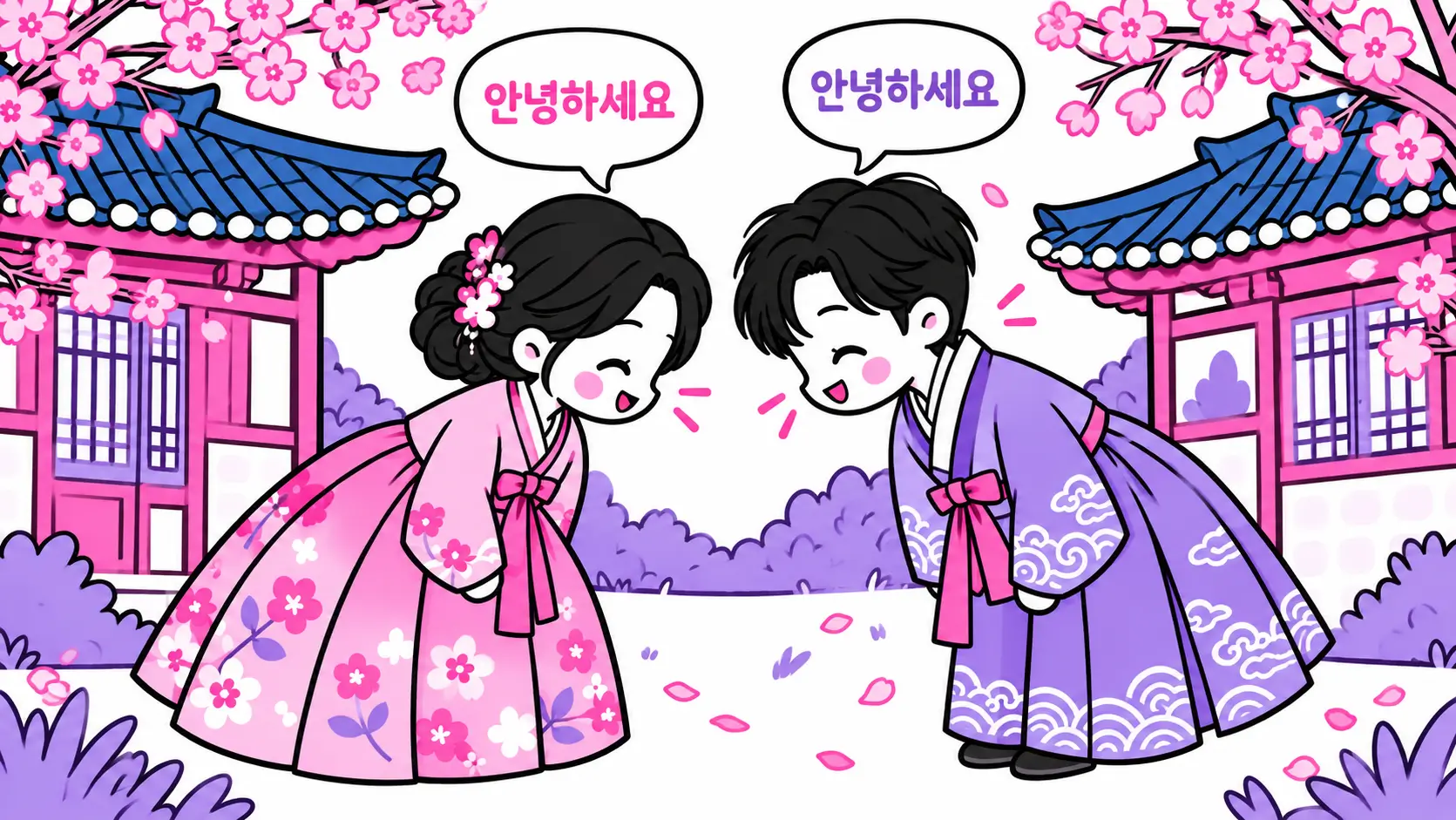
The most common way to say “Hello” in Korean is 안녕하세요 (Annyeonghaseyo). You can use this with strangers, teachers, coworkers, and people you meet every day.
But here’s something interesting: Koreans don’t greet everyone the same way.
Here are the main Ways to say hello in Korean, depending on the situation and the age of the person you are talking to
- 안녕하세요 (Annyeonghaseyo) – Polite/Standard Hello: Formal way. Use this with strangers, teachers, coworkers, and people you meet every day.
- 안녕하십니까 (Annyeonghasimnikka) – Very formal hello: Use this in formal ceremonies, job interviews, or with high-ranking officials.
- 안녕 (Annyeong),: Casual hi in Korean. You can use this only with close friends, peers, or people close to your age or younger than you.
- 여보세요 (Yeoboseyo) – Phone Hello: Use this when answering a phone call.
In this guide, I’ll walk you through the most useful Korean greetings, explain when to use each one, and show simple examples and quizzes you can practice right away.
How to Say Hello in Korean the Right Way
To say hello in Korean, use 안녕하세요 (Annyeonghaseyo) in most situations. It’s polite, friendly, and appropriate for everyday conversations. With close friends, you can use 안녕 (Annyeong). In highly formal situations, 안녕하십니까 (Annyeonghasimnikka) is another option.
The most important thing to remember is that Korean greetings depend on your relationship with the person you’re speaking to.
Here’s a quick comparison.
| Korean greeting | Romanization | English meaning | When to use |
| 안녕하세요 | Annyeonghaseyo | Hello | Everyday polite situations |
| 안녕하십니까 | Annyeonghasimnikka | Hello | Very formal situations |
| 안녕 | Annyeong | Hi / Bye | Close friends and children |
| 여보세요 | Yeoboseyo | Hello? | Answering the phone |
For example, when I meet a Korean teacher, I would say:
Korean: 선생님, 안녕하세요!
Romanization: Seonsaengnim, annyeonghaseyo!
English: Hello, teacher!
But when I meet a close friend, I can simply say:
Korean: 지민아, 안녕!
Romanization: Jimina, annyeong!
English: Hi, Jimin!
See the difference? Both greetings mean hello, but the level of politeness changes.
The Standard Korean Hello: 안녕하세요 (Annyeonghaseyo)
안녕하세요 (Annyeonghaseyo) means “hello” in Korean and is the safest everyday greeting for beginners. You can use it in the morning, afternoon, or evening.
Unlike English, Korean doesn’t require you to switch between “good morning,” “good afternoon,” and “good evening” throughout the day.
That’s why I recommend learning 안녕하세요 before any other Korean greeting.
Easy Korean examples
Example 1
Korean: 안녕하세요! 저는 민지예요.
Romanization: Annyeonghaseyo! Jeoneun Minji-yeyo.
English: Hello! I’m Minji.
Example 2
Korean: 안녕하세요! UPDATED CONTENT: 잘 지내셨어요? is a common way of saying hello in a friendly manner.
Romanization: Annyeonghaseyo! Jal jinaesyeosseoyo?
English: Hello! Have you been well?
Example 3
Korean: 안녕하세요! 저는 한국어를 배우고 있어요.
Romanization: Annyeonghaseyo! Jeoneun hangugeoreul baeugo isseoyo.
English: Hello! I’m learning Korean.
One thing I love about 안녕하세요 is that you can use it confidently in so many situations, from entering a Korean restaurant to introducing yourself to someone new.
“Hello” in Korean (Formal)- Common phrase for formal Korean greetings
Formal Korean greetings are used when you want to show a higher level of respect. You may hear them during business presentations, official ceremonies, interviews, or when meeting important guests.
Let’s look at three useful expressions.
안녕하십니까 (Annyeonghasimnikka)- standard way to greet someone in formal situations
안녕하십니까 (Annyeonghasimnikka) is a very formal way to say hello in Korean. It’s more formal than 안녕하세요 and is common in official speeches, announcements, and structured professional introductions.
You don’t need to use it every time you speak to an older person. In most everyday situations, 안녕하세요 is already polite enough.
Easy Korean examples
Example 1
Korean: 여러분, 안녕하십니까?
Romanization: Yeoreobun, annyeonghasimnikka?
English: Hello, everyone.
Example 2
Korean: 안녕하십니까? 저는 김민수입니다.
Romanization: Annyeonghasimnikka? Jeoneun Gim Minsu-imnida.
English: Hello. I’m Kim Minsu.
I recommend practicing this greeting if you’re preparing for a formal Korean presentation or business introduction.
처음 뵙겠습니다 (Cheoeum Boepgesseumnida)- Polite way of saying hello
처음 뵙겠습니다 (Cheoeum boepgesseumnida) means “It’s a pleasure to meet you for the first time.” It’s a respectful expression used when meeting someone for the first time.
Technically, it’s an introduction phrase rather than a direct translation of “hello.” However, Koreans often use it alongside a greeting.
Easy Korean examples
Example 1
Korean: 안녕하세요. 처음 뵙겠습니다.
Romanization: Annyeonghaseyo. Cheoeum boepgesseumnida.
English: Hello. It’s a pleasure to meet you.
Example 2
Korean: 처음 뵙겠습니다. 잘 부탁드립니다.
Romanization: Cheoeum boepgesseumnida. Jal butakdeurimnida.
English: It’s a pleasure to meet you. I look forward to working with you.
I would use this expression when meeting a new business contact or being formally introduced to someone.
만나서 반갑습니다 (Mannaseo Bangapseumnida)
만나서 반갑습니다 (Mannaseo bangapseumnida) means “Nice to meet you” in Korean. It’s a polite, formal expression you can use when meeting someone new.
If you want a slightly less formal version, you can say 만나서 반가워요 (Mannaseo bangawoyo).
Easy Korean examples
Example 1
Korean: 안녕하세요! 만나서 반갑습니다.
Romanization: Annyeonghaseyo! Mannaseo bangapseumnida.
English: Hello! Nice to meet you.
Example 2
Korean: 저도 만나서 반갑습니다.
Romanization: Jeodo mannaseo bangapseumnida.
English: Nice to meet you, too.
I like this expression because it works naturally in introductions, language exchanges, and professional meetings.
“Hello” in Korean (Informal)-way to say hello with close friends
The most common informal Korean hello is 안녕 (Annyeong). You can use it with close friends, younger family members, and people who have agreed to speak casually with you.
Informal Korean phrases is called 반말 (Banmal).
One thing you should know is that being friendly doesn’t automatically mean you should use informal speech. Age, familiarity, and your relationship all matter.
안녕 (Annyeong)- common way to say hi in korean
안녕 (Annyeong) means “hi” or “bye” in casual Korean, a common way to say hello among friends. It’s the easiest informal greeting to learn.
You will hear it frequently in K-dramas, casual conversations, and messages between friends.
Easy Korean examples
Example 1
Korean: 수아야, 안녕!
Romanization: Suaya, annyeong!
English: Hi, Sua!
Example 2
Korean: 안녕! 오늘 뭐 해?
Romanization: Annyeong! Oneul mwo hae?
UPDATED CONTENT: English: Hi! It’s a common way of saying hello in Korean. What are you doing today?
Remember that 안녕 can mean both hello and goodbye, depending on the situation.
야 (Ya)-
야 (Ya) means something like “Hey!” in Korean, but it’s an attention-getter rather than a normal greeting.
You may hear it between close friends, especially in K-dramas.
However, I wouldn’t recommend using 야 with strangers, teachers, or older people. Depending on your tone, it can sound rude or confrontational.
Easy Korean examples
Example 1
Korean: 야, 이거 봐!
Romanization: Ya, igeo bwa!
English: Hey, look at this!
Example 2
Korean: 야, 어디 가?
Romanization: Ya, eodi ga?
English: Hey, where are you going?
I suggest understanding 야 when you hear it, but using 안녕 when you want to greet someone casually.
왔어? (Wasseo?)-way to say hello among friends
왔어? (Wasseo?) means “You’re here?” or “Did you arrive?” UPDATED CONTENT: It’s a casual expression you can use when someone arrives, making it a common way to greet friends.
It isn’t a universal replacement for hello. Instead, it works as a situational greeting used with close friends.
Easy Korean examples
Example 1
Korean: 어, 왔어?
Romanization: Eo, wasseo?
English: Oh, you’re here?
Example 2
Korean: 벌써 왔어?
UPDATED CONTENT: Romanization: Beolsseo wasseo? This is a way of saying hello in a casual context.
English: You’re here already?
For someone you need to address politely, you can use 오셨어요? (Osyeosseoyo?) instead.
반가워 (Bangawo)
반가워 (Bangawo) means “Nice to see you” or “Nice to meet you” in casual Korean. You can use it when meeting someone new in an informal setting or seeing a friend.
Easy Korean examples
Example 1
Korean: 안녕! 만나서 반가워.
Romanization: Annyeong! Mannaseo bangawo.
English: Hi! Nice to meet you.
Example 2
Korean: 다시 만나서 반가워!
Romanization: Dasi mannaseo bangawo!
English: Nice to see you again!
When you’re chatting with Korean friends, combining 안녕 and 반가워 can make your introduction sound warm and natural.
How to pronounce 안녕하세요?
You can break 안녕하세요 into five Hangul syllable blocks:
안 · 녕 · 하 · 세 · 요
The standard romanization is annyeonghaseyo. The sound of 녕 may take some practice because the Korean ㅕ vowel doesn’t match a single English vowel exactly.
Try saying the greeting slowly first, then gradually increase your speed.
If you’re unsure about the meaning or pronunciation of a Korean word, I recommend checking the Korean-English Learners’ Dictionary from the National Institute of Korean Language.
It’s an official dictionary designed for Korean learners, with definitions and example sentences to help you study pronunciation accurately.
Practice Korean Greetings with Exercises
Now that we’ve learned formal and informal Korean greetings, let’s test what you remember.
Fill-in-the-blank
1. You meet your Korean teacher. UPDATED CONTENT: ________, 선생님! This is a familiar way of saying hello to a teacher.
안녕
안녕하세요
야
2. You meet a close friend. ________!
안녕
안녕하십니까
여보세요
3. You meet a new business partner. 처음 ________.
왔어
뵙겠습니다
먹었어요
Score: 0 / 3
Try again
Multiple Choice
Question: Which Korean greeting is most appropriate when answering a phone call?
안녕 (Annyeong)
여보세요 (Yeoboseyo)
반가워 (Bangawo)
Cute Way to Say Hi in Korean(informal way)
If you watch Korean dramas or follow Korean social media, you might notice playful greetings like 안뇽 (Annyong), which is a common way to say hello.
안뇽 is a cute, informal spelling of 안녕, often used in messages or playful conversations.
Another expression you may encounter is 하이 (Hai), a Korean spelling of the English word “hi.”
| Korean | Romanization | English meaning | When to use |
| 안뇽 | Annyong | Hiii! | Cute, playful chats |
| 하이 | Hai | Hi | Casual conversations and text messages |
| 안녕~ | Annyeong~ | Hiii / Hi there | Friendly text messages |
| 방가방가 | Bangga bangga | Hi! / Glad to see you! | Playful, somewhat old-fashioned chat slang |
| ㅎㅇ | Hai | Hi | Short-form texting and online chats |
The expressions 방가방가 and ㅎㅇ are particularly associated with informal online communication, so I recommend using them only with people you’re comfortable speaking casually with
Easy Korean examples
Example 1
Korean: 안뇽! 뭐 해?
Romanization: Annyong! Mwo hae?
English: Hiii! What are you doing?
Example 2
Korean: 하이! 오랜만이야!
Romanization: Hai! Oraenmaniya!
English: Hi! Long time no see!
I would save these cute Korean greetings for friends, playful text messages, or people I’m already comfortable with.
How Do You Say Hello in Korean on the Phone?
To say hello in Korean on the phone, use 여보세요 (Yeoboseyo). It’s the standard greeting when answering a phone call, especially when you don’t immediately know who’s calling.
Unlike 안녕하세요, which is a general greeting, 여보세요 is primarily used to answer the phone or check whether someone is listening.
Easy Korean examples
Example 1
Korean: 여보세요? 누구세요?
Romanization: Yeoboseyo? Nuguseyo?
English: Hello? Who is this?
Example 2
Korean: 여보세요? 제 목소리 들리세요?
Romanization: Yeoboseyo? Je moksori deulliseyo?
English: Hello? Can you hear my voice?
Example 3
Korean: 여보세요? 민지 씨 계세요?
Romanization: Yeoboseyo? Minji ssi gyeseyo?
English: Hello? Is Minji there?
For professional phone calls, you may also hear people answer by identifying their company or department.
For example:
Korean: 안녕하세요. 한국어 학원입니다.
Romanization: Annyeonghaseyo. Hangugeo hagwonimnida.
English: Hello. This is the Korean language academy.
The main rule I want you to remember is simple: use 여보세요 when answering a phone call, but use 안녕하세요 for ordinary face-to-face greetings.
learn how to say hello in Technology and Modern Korean Greetings
Korean greetings aren’t limited to face-to-face conversations. Today, you’ll also encounter them in video calls, messaging apps, and online communities.
The expressions you choose depend on how formal the interaction is.
Video Call Etiquette
When joining a Korean video meeting, I recommend starting with 안녕하세요, especially if you’re speaking with a teacher, colleague, or someone you don’t know well.
You can follow it with a quick question to check the audio.
Easy Korean examples
Example 1
Korean: 안녕하세요! 제 목소리 들리세요?
Romanization: Annyeonghaseyo! Je moksori deulliseyo?
English: Hello! Can you hear me?
Example 2
Korean: 안녕하세요! 화면 잘 보이세요?
Romanization: Annyeonghaseyo! Hwamyeon jal boiseyo?
English: Hello! Can you see the screen clearly?
If you’re meeting Korean friends over video chat, a simple 안녕! is perfectly natural when you already use casual speech together.
Text and Chat Greetings
In Korean text messages, greetings can be shorter and more playful.
For example, you might see 안녕, 안뇽, or ㅎㅇ, an abbreviation for 하이 (Hai).
However, I wouldn’t use abbreviations in formal emails or professional messages.
Easy Korean examples
Example 1
Korean: 안녕! 지금 시간 있어?
Romanization: Annyeong! Jigeum sigan isseo?
English: Hi! Do you have time now?
Example 2
Korean: 안녕하세요. 문의드릴 게 있어요.
Romanization: Annyeonghaseyo. Munuideuril ge isseoyo.
English: Hello. I have something I’d like to ask about.
A useful tip: when messaging a Korean teacher or coworker, start politely unless you’ve already established a more casual relationship.
How Do You Respond to Annyeonghaseyo?
The easiest way to respond to 안녕하세요 (Annyeonghaseyo) is to say 안녕하세요 back.
You don’t need a complicated response. Just smile, give a small polite nod or bow when appropriate, and return the greeting.
Here are a few natural responses.
| Someone says | You can respond | English |
| 안녕하세요! | 안녕하세요! | Hello! |
| 안녕하세요! 잘 지내셨어요? | 네, 잘 지냈어요. | Yes, I’ve been well. |
| 만나서 반갑습니다. | 저도 만나서 반갑습니다. | Nice to meet you, too. |
| 안녕! | 안녕! | Hi! |
Example Korean Phrases
UPDATED CONTENT: Korean conversation often includes various ways of saying hello.
A: 안녕하세요!
Annyeonghaseyo!
Hello!
B: 네, 안녕하세요!
Ne, annyeonghaseyo!
Yes, hello!
Example 2
A: 안녕하세요! 잘 지내셨어요?
Annyeonghaseyo! Jal jinaesyeosseoyo?
Hello! Have you been well?
B: 네, 잘 지냈어요. 감사합니다.
Ne, jal jinaesseoyo. Gamsahamnida.
Yes, I’ve been well. Thank you.
If you’re a beginner, I recommend practicing the first conversation until it feels natural.
Cultural Tip When Saying “Hello” in Korean
In Korean culture, greetings are about more than just words. They can also communicate respect, friendliness, and awareness of social relationships.
One of the most noticeable customs is bowing.
When greeting an older person, teacher, or someone in a professional setting, a small bow or respectful nod often accompanies 안녕하세요.
You don’t need to perform a deep bow every time you greet someone. The situation determines how formal your greeting should be.
If you want to understand why Korean greetings change depending on age, familiarity, and social relationships, you can explore the Korean speech levels overview on Wikipedia. UPDATED CONTENT: It explains how Korean verb endings communicate formality and politeness in conversation, which is essential in language learning.
Easy Korean example
Korean: 할머니, 안녕하세요!
Romanization: Halmeoni, annyeonghaseyo!
English: Hello, Grandma!
When I practice Korean greetings, I try to pay attention to body language as well as words.
A small bow or respectful nod can make your greeting feel more natural, especially when meeting elders, teachers, or someone in a formal setting.
If you’re curious about Korean customs and etiquette, I recommend exploring the official Korea Tourism Organization website, where you can learn more about Korean culture and everyday traditions.
Essential Korean greetings to say Hello at the Workplace
In a Korean workplace, 안녕하세요 is the most practical everyday greeting. For formal presentations or ceremonial introductions, 안녕하십니까 may be more appropriate.
You may also hear 수고하셨습니다 (Sugohasyeotseumnida), meaning “Thank you for your hard work,” especially when acknowledging someone’s effort or finishing work.
However, 수고하셨습니다 isn’t a direct translation of hello.
Example Korean phrases
Example 1: Greeting a coworker
Korean: 안녕하세요! 오늘도 잘 부탁드립니다.
Romanization: Annyeonghaseyo! Oneuldo jal butakdeurimnida.
English: Hello! I look forward to working with you today.
Example 2: Formal introduction
Korean: 안녕하십니까? 신입 사원 김민수입니다.
Romanization: Annyeonghasimnikka? Sinip sawon Gim Minsu-imnida.
English: Hello. I’m Kim Minsu, a new employee.
Example 3: Meeting a manager
Korean: 부장님, 안녕하세요.
Romanization: Bujangnim, annyeonghaseyo.
English: Hello, Manager.
If you’re unsure which greeting to use at work, I recommend starting with 안녕하세요 rather than using casual expressions.
Mistakes Foreigners Make with 안녕하세요
Even though 안녕하세요 is beginner-friendly, there are a few common mistakes you should avoid.
1. Using 안녕 with everyone
안녕 sounds friendly, but it can be inappropriate when speaking to strangers, teachers, or older people.
Instead of saying 안녕 to someone you don’t know, use 안녕하세요.
2. Using 여보세요 for every greeting
여보세요 is mainly a telephone expression. It’s not the normal way to greet someone when entering a shop or meeting a friend.
3. Thinking 안녕하세요 means only “good morning”
You can use 안녕하세요 at any time of day. You don’t need a different standard greeting for the afternoon or evening.
4. Assuming every older person requires 안녕하십니까
Although respect is important, 안녕하세요 is appropriate for most everyday interactions with older people.
5. Pronouncing every romanized syllable like English
Romanization is useful for beginners, but it doesn’t perfectly represent Korean sounds.
For example, the Korean vowel ㅓ and the vowel combination ㅕ don’t have exact English equivalents.
I recommend learning Hangul early so you can gradually depend less on romanization.
Correct Korean example
Korean: 실례합니다. 안녕하세요.
Romanization: Sillyehamnida. Annyeonghaseyo.
English: Excuse me. Hello.
This is a polite way to begin an interaction when you need someone’s attention.
Essential Useful Korean Greetings for Every Situation
Now that we’ve covered the basic ways to say hello in Korean, let’s explore some common ways to say greetings you can use in everyday life.
Koreans don’t always use a direct equivalent of “hello.” Sometimes, they greet people by asking about their day, their health, or whether they’ve eaten.
Learning these expressions will help you understand more natural Korean conversations.
Time-Based Greeting in Korean
Unlike English, Korean doesn’t normally require separate greetings for morning, afternoon, and evening.
You can simply say 안녕하세요 at any time of day.
However, there are several time-related expressions worth learning.
좋은 아침이에요 (Joeun Achimieyo)
좋은 아침이에요 (Joeun achimieyo) means “Good morning” in Korean. It’s a polite expression you can use to greet someone in the morning.
Although it’s understandable and used in modern Korean, 안녕하세요 is still the more versatile everyday greeting.
Easy Korean examples
Example 1
Korean: 좋은 아침이에요! 잘 잤어요?
Romanization: Joeun achimieyo! Jal jasseoyo?
English: Good morning! Did you sleep well?
Example 2
Korean: 좋은 아침이에요! 오늘 날씨가 좋네요.
Romanization: Joeun achimieyo! Oneul nalssiga jonneyo.
English: Good morning! The weather is nice today.
좋은 아침 (Joeun Achim)
좋은 아침 (Joeun achim) means “Good morning” in a casual, shortened form.
You can use it playfully with close friends or family. It’s less conventional than 안녕 as an everyday casual greeting.
Easy Korean examples
Example 1
Korean: 좋은 아침! 잘 잤어?
Romanization: Joeun achim! Jal jasseo?
English: Good morning! Did you sleep well?
Example 2
Korean: 좋은 아침! 오늘 뭐 해?
Romanization: Joeun achim! Oneul mwo hae?
English: Good morning! What are you doing today?
안녕히 주무셨어요? (Annyeonghi Jumusyeosseoyo?)
안녕히 주무셨어요? (Annyeonghi jumusyeosseoyo?) is a polite way to say goodnight in Korean. means “Did you sleep well?” It’s a respectful morning expression, especially useful when greeting older family members.
It isn’t a literal translation of “good morning,” but it can serve a similar social purpose.
Easy Korean examples
Example 1
Korean: 할머니, 안녕히 주무셨어요?
Romanization: Halmeoni, annyeonghi jumusyeosseoyo?
English: Grandma, did you sleep well?
Example 2
Korean: 아버지, 안녕히 주무셨어요?
Romanization: Abeoji, annyeonghi jumusyeosseoyo?
English: Dad, did you sleep well?
I recommend learning this expression if you’re interested in respectful Korean family conversations.
좋은 밤 되세요 (Joeun Bam Doeseyo)
좋은 밤 되세요 (Joeun bam doeseyo) means “Have a good night.” It’s a polite evening wish, often used when ending a conversation.
This expression is more of a farewell than an opening greeting, but it’s still a polite way to say goodbye. It’s also less conventional than 잘 자요 (Jal jayo) or 안녕히 주무세요 (Annyeonghi jumuseyo) when wishing someone good sleep.
Easy Korean examples
Example 1
Korean: 좋은 밤 되세요! 내일 봐요.
Romanization: Joeun bam doeseyo! Naeil bwayo.
English: Have a good night! See you tomorrow.
Example 2
Korean: 오늘도 수고하셨어요. 좋은 밤 되세요!
UPDATED CONTENT: Romanization: Oneuldo sugohasyeosseoyo. This phrase is commonly used among friends. Joeun bam doeseyo!
English: Thank you for your hard work today. Have a good night!
Essential Korean Greetings for every situation
Some Korean greetings are really questions that show interest in another person’s life.
Let’s explore three expressions you may hear in natural conversations.
밥 먹었어요? (Bap Meogeosseoyo?)
밥 먹었어요? (Bap meogeosseoyo?) means “Have you eaten?” It’s a familiar, caring question that can sometimes function as a greeting.
Food plays an important role in Korean social interactions, and asking whether someone has eaten can be a way to show concern for their well-being.
However, it’s not a universal replacement for 안녕하세요. People also ask this question literally.
Easy Korean examples
Example 1
Korean: 밥 먹었어요?
Romanization: Bap meogeosseoyo?
English: Have you eaten?
Example 2
Korean: 네, 먹었어요. 감사합니다.
Romanization: Ne, meogeosseoyo. Gamsahamnida.
English: Yes, I have. Thank you.
When I hear this expression, I pay attention to the situation before deciding whether the speaker is making conversation or genuinely asking about food.
어디 가세요? (Eodi Gaseyo?)
어디 가세요? (Eodi gaseyo?) means “Where are you going?” It can be a friendly question when you meet someone who is heading somewhere.
In familiar settings, it may function as casual small talk.
However, depending on the relationship, it can also sound like a genuine question about someone’s destination.
Easy Korean examples
Example 1
Korean: 안녕하세요! 어디 가세요?
Romanization: Annyeonghaseyo! Eodi gaseyo?
English: Hello! Where are you going?
Example 2
Korean: 시장에 가요.
Romanization: Sijange gayo.
English: I’m going to the market.
I recommend using this expression with people you already know rather than immediately asking strangers where they’re going.
오랜만이에요 (Oraenmanieyo)
오랜만이에요 (Oraenmanieyo) means “Long time no see” in Korean. It’s a polite expression used when meeting someone you haven’t seen for a while.
With close friends, you can say 오랜만이야 (Oraenmaniya).
Easy Korean examples
Example 1
Korean: 안녕하세요! 오랜만이에요.
Romanization: Annyeonghaseyo! Oraenmanieyo.
English: Hello! Long time no see.
Example 2
Korean: 정말 오랜만이에요! 잘 지내셨어요?
Romanization: Jeongmal oraenmanieyo! Jal jinaesyeosseoyo?
English: It’s been such a long time! Have you been well?
This is one of my favorite Korean greetings to learn because it’s useful whenever you reconnect with someone.
Korean Greetings by Age and Level of formality
In Korean, the way you greet someone often depends on their age, social position, and how close you are.
Korean uses speech levels and honorific expressions to communicate these relationships. Linguistic research on Korean politeness explains how verb endings and terms of address help speakers express respect and social distance.
For beginners, I recommend focusing on three situations.
Speaking to Elders and Superiors
When speaking to older people, teachers, managers, or people in positions of authority, I recommend using polite language.
안녕하세요 is appropriate for most everyday situations.
Easy Korean examples
Example 1
Korean: 선생님, 안녕하세요!
Romanization: Seonsaengnim, annyeonghaseyo!
English: Hello, teacher!
Example 2
Korean: 할아버지, 안녕하세요!
Romanization: Harabeoji, annyeonghaseyo!
English: Hello, Grandpa!
Speaking to Peers
When speaking to someone around your age, the greeting depends on how well you know each other.
If you’ve just met, start with 안녕하세요. Once you’re close and comfortable using informal Korean, 안녕 may be appropriate.
Easy Korean examples
Example 1: Someone new
Korean: 안녕하세요! 저는 수진이에요.
Romanization: Annyeonghaseyo! Jeoneun Sujin-ieyo.
English: Hello! I’m Sujin.
Example 2: Close friend
Korean: 안녕! 오늘 학교 가?
Romanization: Annyeong! Oneul hakgyo ga?
English: Hi! Are you going to school today?
Speaking to Younger People or Children
When speaking to young children or younger people you’re close to, you can often use 안녕.
However, I wouldn’t assume that every younger stranger should automatically be addressed informally. Polite speech can still be the most appropriate choice.
Easy Korean examples
Example 1
Korean: 안녕! 이름이 뭐야?
Romanization: Annyeong! Ireumi mwoya?
English: Hi! What’s your name?
Example 2
Korean: 안녕! 오늘 재미있게 놀았어?
Romanization: Annyeong! Oneul jaemiitge norasseo?
English: Hi! Did you have fun today?
How to Practice Korean Greetings
Learning Korean greetings is much easier when you use them in realistic situations.
You don’t need to memorize every expression in one day. I recommend starting with a few useful greetings and practicing them regularly.
1. Start Every Study Session with a Greeting
Before you begin studying Korean, say one greeting aloud.
For example:
Korean: 안녕하세요! 오늘도 한국어를 공부해요.
Romanization: Annyeonghaseyo! Oneuldo hangugeoreul gongbuhaeyo.
English: Hello! I’m studying Korean again today.
This helps you build a consistent speaking habit.
If you want to improve your Korean beyond basic greetings, I recommend exploring the Online King Sejong Institute. It’s an official Korean-language learning platform where you can find structured lessons and learning materials. I suggest using it alongside your daily greeting practice to build your vocabulary, grammar, listening, and conversation skills.
2. Practice with AI Conversation Partners
You can use an AI conversation partner to practice formal and informal Korean greetings.
For example, I would use a prompt like this:
“Act as my Korean language partner. I’m a beginner. Greet me in Korean, ask one simple question, and correct my grammar politely.”
Then practice conversations such as:
Korean:
A: 안녕하세요! 이름이 뭐예요?
B: 저는 민지예요.
Romanization:
A: Annyeonghaseyo! Ireumi mwoyeyo?
B: Jeoneun Minji-yeyo.
English:
A: Hello! What’s your name?
B: I’m Minji.
AI practice is useful for repetition, but I recommend checking unfamiliar expressions against reliable Korean learning resources.
3. Watch K-Dramas with a Greeting Focus
K-dramas can help you hear how Korean greetings change depending on the relationship between speakers.
When watching, pay attention to whether characters say 안녕하세요, 안녕, or 안녕하십니까.
Try this exercise: watch a short conversation, pause after the greeting, and repeat the expression aloud.
4. Practice the Bowing Motion
You can also practice pairing your greeting with a small respectful bow.
Say:
Korean: 안녕하세요.
Romanization: Annyeonghaseyo.
English: Hello.
Then give a small nod or bow, as appropriate for the situation.
I find it helpful to practice the words and gestures together so the greeting feels more natural.
5. Role-Play Different Scenarios
One of the best ways to remember Korean greetings is to imagine real-life situations.
Try practicing these three scenarios.
| Scenario | What you say | English |
| Meeting a teacher | 안녕하세요, 선생님! | Hello, teacher! |
| Meeting a friend | 안녕! | Hi! |
| Answering the phone | 여보세요? | Hello? |
You can also practice with a friend and switch roles after each conversation.
If you’re looking for structured Korean lessons, I recommend the Online King Sejong Institute. It offers Korean language courses and self-study materials, so you can practice greetings alongside grammar, listening, and everyday conversation skills.
Quick Reference: Korean Greetings Cheat Sheet
Here’s a simple cheat sheet you can save for quick revision.
| Korean | Romanization | English meaning | Best situation |
| 안녕하세요 | Annyeonghaseyo | Hello | Everyday polite greeting |
| 안녕하십니까 | Annyeonghasimnikka | Hello | Very formal greeting |
| 안녕 | Annyeong | Hi / Bye | Close friends |
| 여보세요 | Yeoboseyo | Hello? | Answering the phone |
| 처음 뵙겠습니다 | Cheoeum boepgesseumnida | Pleasure to meet you | Formal first meeting |
| 만나서 반갑습니다 | Mannaseo bangapseumnida | Nice to meet you | Polite introduction |
| 반가워 | Bangawo | Nice to see you | UPDATED CONTENT: Casual meeting can be a great opportunity for language learning. |
| 안뇽 | Annyong | Hiii! | Playful messages |
| 좋은 아침이에요 | Joeun achimieyo | Good morning | Morning greeting |
| 안녕히 주무셨어요? | Annyeonghi jumusyeosseoyo? | Did you sleep well? | Respectful morning greeting |
| 좋은 밤 되세요 | Joeun bam doeseyo | Have a good night | Evening farewell |
| 밥 먹었어요? | Bap meogeosseoyo? | Have you eaten? | UPDATED CONTENT: Familiar conversation often includes a variety of Korean phrases. |
| 어디 가세요? | Eodi gaseyo? | Where are you going? | Familiar small talk |
| 오랜만이에요 | Oraenmanieyo | Long time no see | Reunion |
If you remember only three expressions from this guide, make them 안녕하세요, 안녕, and 여보세요.
These three will help you handle many common greeting situations.
Practice Greetings with Exercises
Let’s see how much you’ve learned.
Fill-in-the-blank
Choose the best Korean greeting for each situation.
1. You’re answering a phone call.
여보세요
안녕
반가워
2. You see a close friend after a long time.
오랜만이야
안녕하십니까
처음 뵙겠습니다
3. You’re introducing yourself at a formal event.
야
안녕하십니까
왔어?
4. You meet a new Korean teacher.
안뇽
야
안녕하세요
5. You greet your close friend casually.
안녕
여보세요
처음 뵙겠습니다
Score: 0 / 5
Reset quiz
Multiple Choice
Which expression means “Nice to meet you” in polite Korean?
어디 가세요?
만나서 반갑습니다
좋은 밤 되세요
Frequently Asked Questions About Korean Greetings
What does annyeonghaseyo literally mean?
안녕하세요 (Annyeonghaseyo) means “hello,” but its underlying meaning relates to being peaceful or well. The word 안녕 (Annyeong) refers to peace or well-being, and the complete expression developed into a conventional polite greeting.
In modern Korean, you don’t need to interpret it as a literal question about someone’s health. You can simply use it to say hello.
Is it okay to say 안녕 to everyone?
No. 안녕 (Annyeong) is an informal greeting, so I recommend using it with close friends, children, or people with whom you already use casual Korean.
When greeting strangers, teachers, or older people you don’t know well, 안녕하세요 is the safer choice.
How to say goodbye in Korean
The two most useful polite Korean goodbye expressions are 안녕히 가세요 (Annyeonghi gaseyo) and 안녕히 계세요 (Annyeonghi gyeseyo).
The expression you choose depends on whether the other person is leaving or staying.
Korean: 안녕히 가세요!
Romanization: Annyeonghi gaseyo!
English: Goodbye! (Said to someone leaving.)
Korean: 안녕히 계세요!
Romanization: Annyeonghi gyeseyo!
English: Goodbye! (Said when you’re leaving someone who is staying.)
With close friends, you can simply say 안녕 (Annyeong).
How do Koreans greet on the phone?
Koreans commonly answer phone calls with 여보세요 (Yeoboseyo), meaning “Hello?”
In professional calls, people may also identify themselves or their organization.
Do I have to bow when saying hello in Korean?
No, you don’t have to bow every time you say hello in Korean.
However, a small bow or respectful nod is common when greeting teachers, elders, and people in professional situations.
I recommend observing the setting and following the other person’s level of formality.
Korean: 교수님, 안녕하세요!
Romanization: Gyosunim, annyeonghaseyo!
English: Hello, Professor!
What is the difference between 안녕히 가세요 and 안녕히 계세요?
안녕히 가세요 is said to someone who is leaving, while 안녕히 계세요 is said when you leave someone who is staying.
Here’s a quick comparison.
| Expression | Romanization | When to use |
| 안녕히 가세요 | Annyeonghi gaseyo | The other person is leaving |
| 안녕히 계세요 | Annyeonghi gyeseyo | You are leaving; the other person stays |
How do you say “nice to meet you” in Korean?
The polite formal expression is 만나서 반갑습니다 (Mannaseo bangapseumnida).
For everyday polite conversations, you can use 만나서 반가워요 (Mannaseo bangawoyo).
With close friends or in casual situations, you can say 만나서 반가워 (Mannaseo bangawo).
Why do Koreans ask “Have you eaten?” as a greeting?
Koreans sometimes ask 밥 먹었어요? (Bap meogeosseoyo?), meaning “Have you eaten?”, as a familiar way of showing concern.
Food and shared meals are important parts of everyday social interaction, so the question can express care.
However, it’s also a literal question and shouldn’t be treated as a standard greeting in every situation.
Can I use English greetings in Korea?
Yes. Some Koreans understand and use English greetings like “Hi” and “Hello,” especially in casual or international settings.
You may even see 하이 (Hai), the Korean spelling of “hi,” in messages.
However, I recommend learning 안녕하세요 because it works in many more everyday Korean-speaking situations.
Korean: 하이! 오늘 어때?
Romanization: Hai! Oneul eottae?
English: Hi! How are things today?
What’s the best way to practice Korean greetings?
I recommend practicing greetings through short daily conversations, listening exercises, and realistic role-play.
Start with 안녕하세요, 안녕, and 여보세요. Then add more expressions as you become comfortable.
How do you say hello in Korean in formal and informal situations?
In formal situations, you can say 안녕하십니까 (Annyeonghasimnikka). In everyday polite situations, use 안녕하세요 (Annyeonghaseyo). With close friends, say 안녕 (Annyeong).
Here’s a simple comparison.
| Formality | Korean | Romanization |
| Very formal | 안녕하십니까 | Annyeonghasimnikka |
| Polite | 안녕하세요 | Annyeonghaseyo |
| Informal | 안녕 | Annyeong |
What cultural rules should you know when greeting someone in Korean?
When greeting someone in Korean, the most important cultural rule is to consider your relationship with the other person.
Age, social status, familiarity, and the situation can influence the politeness level you choose.
I recommend using 안녕하세요 when you’re unsure, adding a respectful nod when appropriate, and avoiding casual expressions like 야 with strangers.
What are some other common Korean greetings?
Besides 안녕하세요, you can learn expressions such as 오랜만이에요 (Long time no see), 잘 지냈어요? (Have you been well?), and 좋은 아침이에요 (Good morning).
How do you pronounce annyeonghaseyo?
안녕하세요 is romanized as Annyeonghaseyo and contains five Hangul syllable blocks: 안-녕-하-세-요.
Start by practicing each block slowly, then connect them naturally.
Pay particular attention to the Korean vowel ㅕ in 녕 and the vowel ㅓ in 안녕. They don’t correspond exactly to ordinary English spellings.
I recommend listening to native Korean audio rather than relying only on English approximations.
Understanding Formality Levels in Korean Greetings
One of the most important things I’ve learned about Korean greetings is that formality isn’t just about sounding polite. It’s also about expressing the relationship between you and the person you’re speaking to.
Korean has a grammatical system of speech levels, and these levels influence verb endings, greetings, and everyday expressions.
For beginners, I recommend understanding three especially useful categories.
1. Formal Polite Speech — 합쇼체 (Hapsyoche)
This style is associated with formal announcements, presentations, official situations, and respectful professional communication.
A common greeting is 안녕하십니까.
Korean: 안녕하십니까? 저는 박지훈입니다.
Romanization: Annyeonghasimnikka? Jeoneun Bak Jihun-imnida.
English: Hello. I’m Park Jihun.
For a deeper understanding of Korean politeness, I recommend the academic chapter Linguistic Politeness in Korean: Speech Levels and Terms of Address by Young Mee Yu Cho and Jaehyun Jo. It explores how speech levels and forms of address reflect relationships between Korean speakers.
2. Everyday Polite Speech — 해요체 (Haeyoche)
This is one of the most useful speech styles for Korean learners.
You’ll encounter it in conversations with strangers, teachers, coworkers, and people you don’t know well.
The standard greeting is 안녕하세요.
Korean: 안녕하세요! 오늘 기분이 어때요?
Romanization: Annyeonghaseyo! Oneul gibuni eottaeyo?
English: Hello! How are you feeling today?
3. Casual Speech — 해체 (Haeche)
This speech style is common between close friends, family members, and people who have an established informal relationship.
A common greeting is 안녕.
Korean: 안녕! 오늘 기분 어때?
Romanization: Annyeong! Oneul gibun eottae?
English: Hi! How are you feeling today?
Formal vs. informal Korean greetings: final comparison
| Feature | Formal polite | Everyday polite | Casual |
| Korean speech style | 합쇼체 | 해요체 | 해체 |
| Common hello | 안녕하십니까 | 안녕하세요 | 안녕 |
| Typical situation | Official presentations | UPDATED CONTENT: Everyday conversations often include various Korean phrases. | Close friends |
| Respect level | High | Polite | Familiar |
| Beginner priority | Learn after basics | Learn first | Learn second |
Korean speech levels are more complex than these three categories, but this simplified framework is a useful starting point. You can explore the fuller grammatical system through Wikipedia’s Korean Speech Levels overview and the academic research listed below.
Final Thoughts: Start Saying Hello in Korean Today!
Learning how to say hello in Korean is a small step that can make a big difference in your Korean conversations.
If you’re just getting started, I recommend focusing on these three greetings first:
안녕하세요 (Annyeonghaseyo): Hello — polite and suitable for most everyday situations.
UPDATED CONTENT: 안녕 (Annyeong): Hi — a casual and friendly way of saying hello among friends.
여보세요 (Yeoboseyo): Hello? — used when answering the phone.
Once you’re comfortable with these, you can gradually explore more formal introductions, situational greetings, and Korean honorifics.
Remember, you don’t have to learn every greeting at once. Start with one expression, practice it aloud, and try using it in a simple conversation.
The more you practice, the more naturally you’ll understand when to say 안녕하세요, 안녕, or something else.
And next time you meet someone who speaks Korean, you’ll be ready to greet them with confidence.
안녕하세요! 이제 한국어로 인사할 수 있어요!(Annyeonghaseyo! Ije hangugeoro insahal su isseoyo!)
Hello! Now you can greet people in Korean!


Hi, this is a comment.
To get started with moderating, editing, and deleting comments, please visit the Comments screen in the dashboard.
Commenter avatars come from Gravatar.